This report will actually cover a report from the evening of January 3rd and the morning of January 4th and my observations from the evening of January 13th and the morning of the 14th.
 To highlight what I have and am using here is a listing of my equipment. I have an Orion Classic XT8 that is my primary scope, while also owning an Orion XT6 that my son and my students use. I have the 25mm and the 10mm Sirius Plossls that came with each scope as well as the following eyepieces:
Orion Sirius Plossls 32mm, 17mm,
Orion Expanse 9mm
Orion Stratus 21mm and 13mm
2x Shorty Barlow
UHC Orion NB Filter
7x35 Binoculars
Telrad
9x50 RA Finderscope
I use the Star Atlas 2000, the Pocket Sky Atlas and several books from time to time in helps in planing my observations.
I observe either from my backyard which is in the western part of the Salt Lake Valley and I have limiting magnitude skies from 5.3 (full moon) to 6.3 to 6.5 when conditions are good. Come spring, summer and fall I have a dark site in the green I go to which is about 45 minutes to an hour from my home.
Sketching is a part of each session as well, and that is why you may see from time to time I do not list eight, ten, twelve or more items in a session, unless I pull a near all night session or an all night session. I will include my sketches though for this entry I will have to return as I haven't scanned them yet.
Why a blog over posting at one of the major amateur astronomy sites on their forums? You'll see I include a lot in a report and I find that in the major astronomy sites that there is a core of people who have posted there and though they are very good at supporting new members, after awhile I just felt like I was either ignored (just to many members) or in terms of sketching, no where near the level of expertise that the core members had. Since these sites don't differentiate between newer members and their observations and sketches and long term members, I've opted to just do a blog. I will continue to read the forums on these sites, and I will participate, I just have decided that for now, blogging on my observations and my sketches is the best way for me to go. Oh, and I have to say, the blog is more for me and a way to keep them online and if someone else leaves advice, I definitely will appreciate it or if someone learns something from it, so much the better.
The night of the 3rd was a good night with seeing conditions at a 3 out of 5. I started out around 9pm and got set up in the backyard. After setting up, I have two pads we use under our sleeping bags in order to lay on the ground. One is 6 feet long so I lay on that, and I keep the other one which is about 3 feet long rolled up to support my head. To dark adapt I take out the 7x35 binocs as I call them and begin observing the sky where I want to observe. I will either do one of two things in my observations. One is to come up with a list of objects and go after them, or pick one part of the sky and make a list of objects and go after them. This night, well you can determine which method I took.
I started at Pollux and jumped down Kappa Gemni and then over to Mu Cancer and then to M44. M44 shows in the 7x35 and is easily seen. From my backyard I can see Asellius Austrailis visually and a faint of a glow above it which is M44. From here I went back to Pollux and went down to Wasat. Using Wasat as the starting point I wanted to observe and went from Wasat to 63 Gemni and began looking for a jump to NGC 2392 (Eskimo Nebula). I've seen NGC 2392 several times before earlier in the late fall early winter, but not at or near zenith. I also went back to M44 the Beehive Cluster and centering on Asellius Asustralis I hopped down to Acubens and went looking for M67. M67 in the binocs was hard to see, but a small glow was visible.
By now I was darked adapted so I put the binocs away and got the XT8 ready to go. I put in the 21mm Stratus, which serves as my finer eyepiece now. I love the wide field of view and have had no major issues with any of my Stratus'. I hopped easily to Wasat and then over to 63 Gemni. From here I got lost. I attempted the jump down to NGC 2392 but failed each time (did a total of 4 attempts). I realized then that I was frustrated and it was time to move on. I also realized that I did a fundemental error in planning this session. I did not look at my previous observations when I successfully had found this. In doing so I would have noted that once I got to 63 Gemni I changed from a low power to the 17mm (in this case I would have used the 13mm) to pull out NGC 2392. I'll have to do that next time (tonight).
Next I went back to Pollux and went to Kappa Gemni and then over to Mu Cancer and over to the Beehive. In the 21mm Stratus the Beehive shows itself to be incredible. It fit into the view (barely and only for a few moments before going out of view for a part of the cluster). I observed the cluster using the 21mm, the 13mm Stratus' and enjoyed both views. With the 13mm I saw the hints of stars wanting to pop out and with averted vision some of them did. I spent about 40 minutes sketching after observing for about fifteen minutes. I'll post my sketch when my son is not using the computer attached to our scanner.
After finishing with M44 The Beehive Cluster I went down to Asellus Asutralis and jumped down to Acubens by passing down past Omicron Cancer (two stars next to each other) and then down to Acuberns. At Acuberns I went over past 60 Cancer and up to M67. In my finder M67 was a blurry object and using the 21mm Stratus I captured this small open cluster right away. M67 is a wonderful cluster and though smaller than its neighbor, M44, is a cluster that I enjoyed observing and sketching. I did not see the King Cobra that this cluster is known for but nevertheless, spending around 15 minutes observing and 35 minutes sketching it.
My next object was M48. It was a night when I wanted to bag some of the larger open clusters. I used the Telrad and went to Sirius and from there hopped and jumped up to M46 and M47 which were visible in the binocs and in the finderscope. From here I jumped up to Alpha Monoceros. From Alpha I went up towards Zeta Monoceros and about 3/4 of the way up went over to the left. M48 was easily seen in the finderscope and in the 21mm Stratus. I went over and was amazed by its sheer size. It has a definite triangular shape and in some ways, reminds me of a crocidile. I observed for 18 minutes on this one because I looked at my watch after recording my observations and writing them down, and then just looking. I pulled my glove down to see how long I had been observing and realized I had been spending about 10 minutes just observing. I moved on to my sketch and this one took a little longer, taking about 40 minutes to get my sketch down. I also took more time sketching since I made a 21mm sketch and a 13mm sketch.
My observations of M48 was my last observation of this session. I had seen M44, M67, M41 (no sketch, just looked at it), M46 and M47 (no sketch though I decided I need to redo my orginal sketches of these objects) and M48. I should have added M93 to this session but as it was now around 3a.m. I decided to bag it.
January 4, 2009
I only had about 2 hours to observe since I had to work and be there early the next morning. I got the equipment out and by the time I had done that I had about an hour to observe. I looked at Cassiopeia tonight and wanted to nab M 52 to the list. I am currently working on completing the Messier Astronomical Award for my local clubs award next fall (along with the best of the NGC). I used the Telrad to Caph and from there I jumped to Cassiopeia 6. From 6 I could see Cassiopeia 4 and hopped over to that star. Once at 4 it was really easy to see M 52 off to the left in the finder or to the right in the 21mm Stratus. M 52 was a large cluster and to its left sits the Bubble Nebula NCG 7635. As I had both objects in view I observed and made my notes on M 52 first. I know some call this the scorpian and I can see that, but the first thing that stuck out to me was the Y shape to the cluster. I spent 14 minutes or so observing and another 30 to 35 minutes sketching M 52.
After finishing with M 52 I went over to the Bubble Nebula and made my observation of the Bubble and sketched it also. I spent a good ten minutes observing and probably 20 minutes sketching it. I put it just outside the eye piece circle of M 52. I really enjoyed the both the Bubble and the Cluster. After observing and sketching both items it was time to take everything in and retire for the night.
January 13, 2009
I spent 15 years in business, ten of those as an excutive and now have spent 9 years as a teacher. One thing I will not do is allow a hobby to intervere with my professional career. It's a commitment I made a long time ago and I've stayed pretty true to it. So tonight is a short observation session again. The skies were clear and with smog coming this weekend I'm not sure how conditions will be.
I got set up and ready to go by 7p.m. tonight and was dark adjusted by 7p.m. when the scope was cooled. I started with observing M 42 since I have wanted to make sketches of it using the 21mm and 13mm Stratus eyepieces. I went to M 42 and just admired the view of the entire nebula in the 21mm Stratus. It was clear, sharp and a wonderful site to see. Prior to sketching, I put in my 9mm Orion Expanse. I know some have had issues with kidney beaning and fade outs, and I did too for the first three or four times I used the eyepiece. Now that I have figures out the eye relief (I am nearsighted and in the past have not worn my eye glasses while observing with the Sirius Plossls I have) and the key for me is wearing my eye glasses with the Expanse, I truly love the views the 9mm Expanse gives to me. Next to my Stratus, they are one of my favorites, and probably will be until I can buy a 8mm Stratus.
Anyway, I took the 21mm Stratus out and put in the 9mm Expanse with the 2x Shorty Barlow and looked at the Trapezium. I was shocked, F was clearly visible. Must be decent conditions tonight. After viewing the Trapezium I took the barlow and the 9mm Expanse and put them back in the case and put the 21mm Stratus back in. I observed for about 10 minutes (I've done my first observation back in October early in the a.m.) and began sketch the nebula. I started with the brighter stars and drew them in four quadrants by dividing the circle into fourths. Then I came back and did the smaller stars. Finally I added the nebula. Though not perfect, I was happy with the overall drawing as I used a stump to put in the nebulosity.
I have been wanting to get M81 and M82 since by the time I started observing last year, it was into September and the Big Dipper was too low for good viewing and more probably, my eyes had not adjusted. I moved the scope around and using the Telrad focused on Dubhe. From there I went out past UM38 and the group of four stars around that star to a bright UM 24 which is part of a long L. Focusing on UM 24 which is at the end of the long L I went east and there was M82 with her long strectch out looking like a cigar. Going over slightly I was ableto see M82 and put both M81 and M82 in the viewing field together. I observed and made notes, noting how M82 looked brighter on the northern side then on its southern side. M81 had a very bright central core area and hints of lighter arms spreading out.
I decided to swap out the 21mm Stratus with the 13mm Stratus and was glad I did. M 82 still showed more brightness on the northern side but it was streched out longer in the 13mm view. M 81 showed far more details in the 13mm. I was able to discern not only a bright core, but several arms stretching out. I also saw some bright stars in the arms, one being very bright on the eastern north/eastern side. M81 has two stars to the NW of it with a smaller star in betwen the two stars. M82 has two stars at and angle to M82 that are near the western bottom of the galaxy. I decided that night to draw M81 and M82 as self contained galaxies, thinking I would come back on my next session to draw them in the same field of view using the 21mm Stratus. As it was now 10:15p.m. I had to wrap ups this session.
January 14th, 2009
Tonight was rather a frustrating night. I set up later in the evening since I took a nap after getting home from work. I did this since I wanted to go back to revisit M 81 and M 82 and to see if I could get M108, M97 and M109.
I got out to M81 and M82 easily and using the 21mm Stratus captured both galaxies in the same sketch. I was rather happy with this view and with the sketch, especially since I felt I captured M 82 better than M81.
After spending time with M81 and M82 and sketching them in the same sketch, I moved down to Merak. From Merak I went down towards Phecda until I came to the first star. I went diagonally down two stars to where I saw a arrow or inverted Y which should have put M108 into view. Nothing. Nothing I did worked. I tried the Q70 32mm, the 21mm Stratus, the 32mm Sirius Plossl and the 13 mm Stratus and 9mm Expanse. Nothing. I didn't expect the high power eyepieces to do anything but the galaxy did not show herself. I though with averted vision I may have had it, but I cannot confirm it so it stays off the list. I tried for M97 both with and without the NB UHC filter I have but no luck there either. I have to assume that since the Big Dipper is to my east and that is where my worse light pollution and worse sky is, that the LP is impacting my ability to see these galaxies and the nebula. Perhaps someone can tell me if I see M 81 and M82 if I should also be able to see M108, M109 and M 87 as well? From what I've read the bad LP can mean I need to go after these at a dark site.
As mentioned, I wet down to Phecda and dropped down to M109 but nothing was there either! I may have to go to my dark site or wait for March to see if position helps then. Since I knew I probably wouldn't find it I also tried to go after M51 but failed at that one also.
Next I went back to M42 and sketched it using the 13mm Stratus. I can't speak enough of the Stratus eyepieces. They are my main eyepieces now for my observing. I'll probably get the 8mm Stratus in time. Plenty of field of view, I can look with my glasses on and I don't have any loss of color to my eye.
From here to close out my observations I went to M93. I use the Telrad to to to Aludra in Canis Major and then hopped over to Zeta in Puppis. From Zeta M93 was easy using the 21mm Stratus. I simply followed the two stars from Zeta that go diagonal and they took me right to M93. M93 is a rather small cluster of stars that to me seems to form the shape of a skunk, or perhaps a racoon with the tail sticking up. Two bright stars seem to form the eyes. There is a definite V pattern to the cluster also.
That was it. Nothing since though I am going out tonight if conditions are good and I hope to stay out late. Last night would have been ok, but I was too tired and just too worn out to go out. I spent the night watching a movie with my wife with the two teens over at a mutal friend to watch movies there.
Clear Skies
Jay
PS I'll post more images of my sketches but probably not until next weekend.
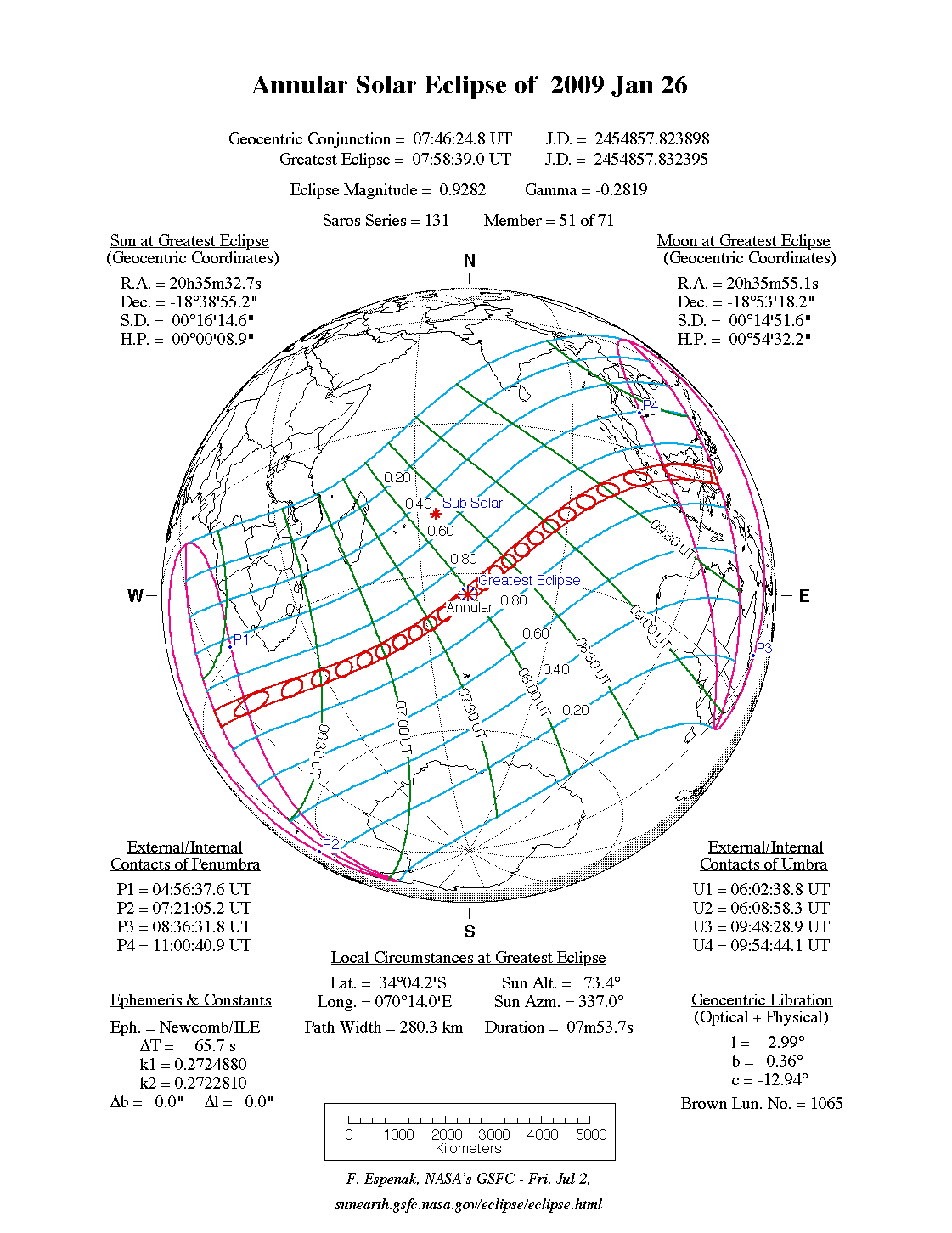
 Annular Eclipse on Jan. 26. Credit: M.R. Taufik